Project overview
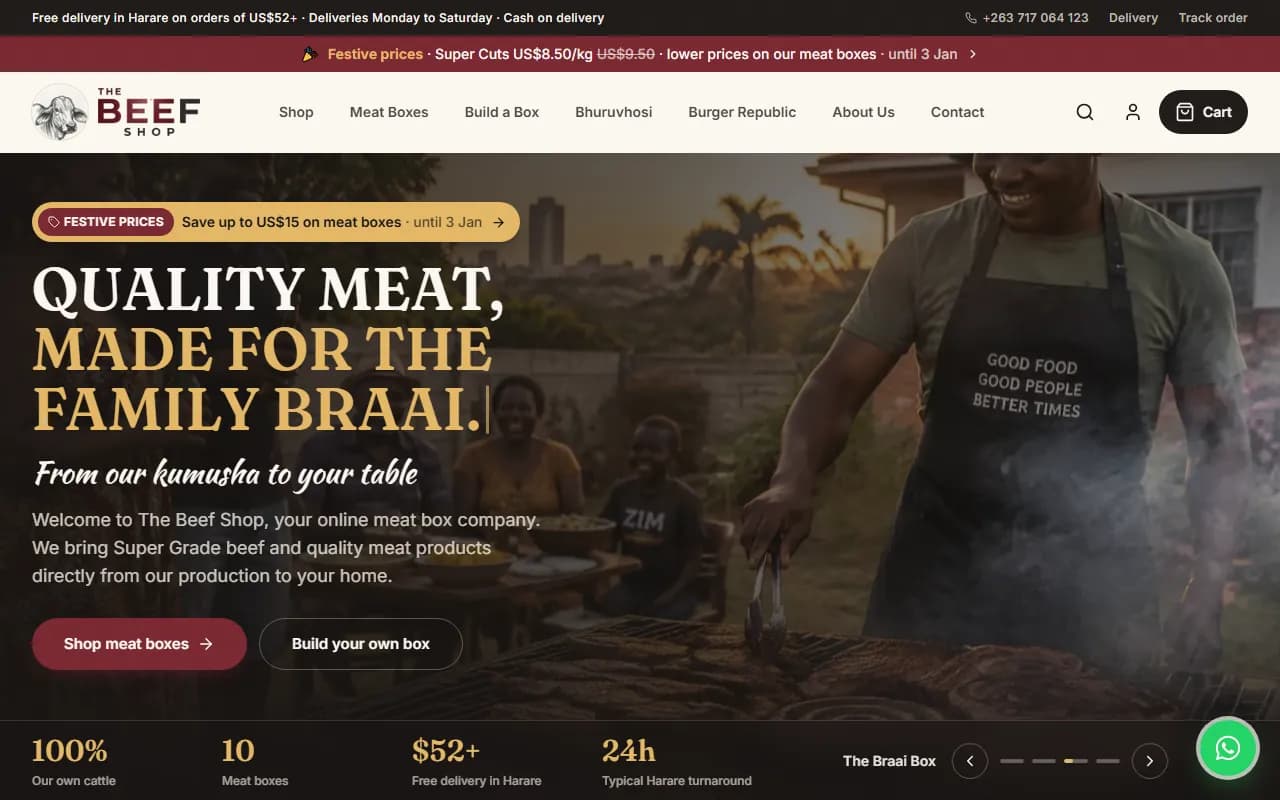
The Beef Shop raises its own cattle near Chihota, Marondera, processes and packs the meat in-house and delivers straight to customers in Harare. It sells ready-made meat boxes, individual cuts, sausages, burger patties and pies, and runs two wholesale divisions: Bhuruvhosi for boerewors and sausages, and Burger Republic for patties.
A first prototype was a single-page sales demo that the client rejected as "too standard". What they needed was not a brochure with a cart but the system the business runs on: one place where the website, WhatsApp orders, production, stock, delivery and the books agree with each other.
The challenge
Most of The Beef Shop's customers order on WhatsApp, some on the website, and wholesale buyers by phone. Each channel had its own prices and its own idea of what was in stock, so customers were quoted different prices and sold cuts that had already run out.
Meat is sold by weight, which ordinary shop software handles badly: a box of 2 kg of mince and 1.5 kg of T-bone has to be priced, packed and delivered exactly as built. Orders also go through more steps than a parcel, from production and packing to a delivery slot on one of the delivery days, and customers expect to be told at every step.
Payment had to work the way Zimbabweans actually pay (EcoCash, OneMoney, InnBucks, O'mari, card, ZIPIT, transfer or cash on delivery), and the owners needed to see revenue, stock and production without exporting spreadsheets.
Our solution
One platform, one PostgreSQL database. The website, the WhatsApp chatbot and the admin dashboard all read and write the same tables through the same Django apps, so there is no second copy of the catalogue to drift out of date.
Storefront. A Next.js (App Router, TypeScript) store, installable as a PWA, with ten standard meat boxes and a box builder: customers pick cuts, set weights and watch the price update live. Products carry stock labels such as low stock and sold out, promotional pricing shows the saving on each item, and reviews are verified purchases, requested automatically 12 to 24 hours after delivery. Checkout takes a delivery date and time, a dropped pin on a map for the exact address and fee, and payment through Paynow or cash on delivery.
WhatsApp commerce. A WhatsApp Cloud API chatbot browses the same catalogue, builds a cart, takes the order and the payment, and hands over to a person when needed. A Gemini-powered assistant answers questions the menus do not cover from the shop's own knowledge base and turns a typed order such as "2 family boxes and 3 kg mince" into cart lines that the server checks against the live catalogue, so it can never invent a price. Facebook Messenger runs through the same engine.
Real time. Daphne serves Django over ASGI so Django Channels can push order status, price and catalogue changes, admin KPIs and agent hand-offs over WebSockets to every open page; customers watch their order move without refreshing.
Operations. A full order lifecycle state machine with delivery and pickup, delivery days and fees; production and carcass tracking; inventory; wholesale accounts and enquiries; a promotions engine with eligibility rules, a CSPRNG prize draw and an exportable audit trail; finance and fiscal records; an audit log; and reports. Celery workers send WhatsApp and email notifications across the order lifecycle and run scheduled jobs.
Infrastructure. Docker Compose runs the storefront, the API, Celery workers and beat, PostgreSQL and Redis behind Nginx, with Caddy for TLS and maintenance mode and rclone off-site backups.
Results
- Put the website, the WhatsApp chatbot and the back office on one database, so prices and stock always agree
- Gave customers a box builder that prices any mix of cuts and weights live
- Took orders and payments inside WhatsApp, with a person one message away
- Answered free-text questions and typed orders with an AI assistant that can only add real catalogue items
- Accepted EcoCash, OneMoney, InnBucks, O'mari, card, ZIPIT, transfer and cash on delivery
- Priced delivery exactly from a dropped map pin, on the shop's own delivery days
- Showed live order status on the website without refreshing
- Kept customers informed on WhatsApp and email at every step of an order
- Collected verified reviews automatically after each delivery
- Ran promotions with an auditable, cryptographically random prize draw
- Gave the owners production, inventory, wholesale, finance and sales reports in one dashboard
- Installed as an app on customers' phones (PWA)