Project overview
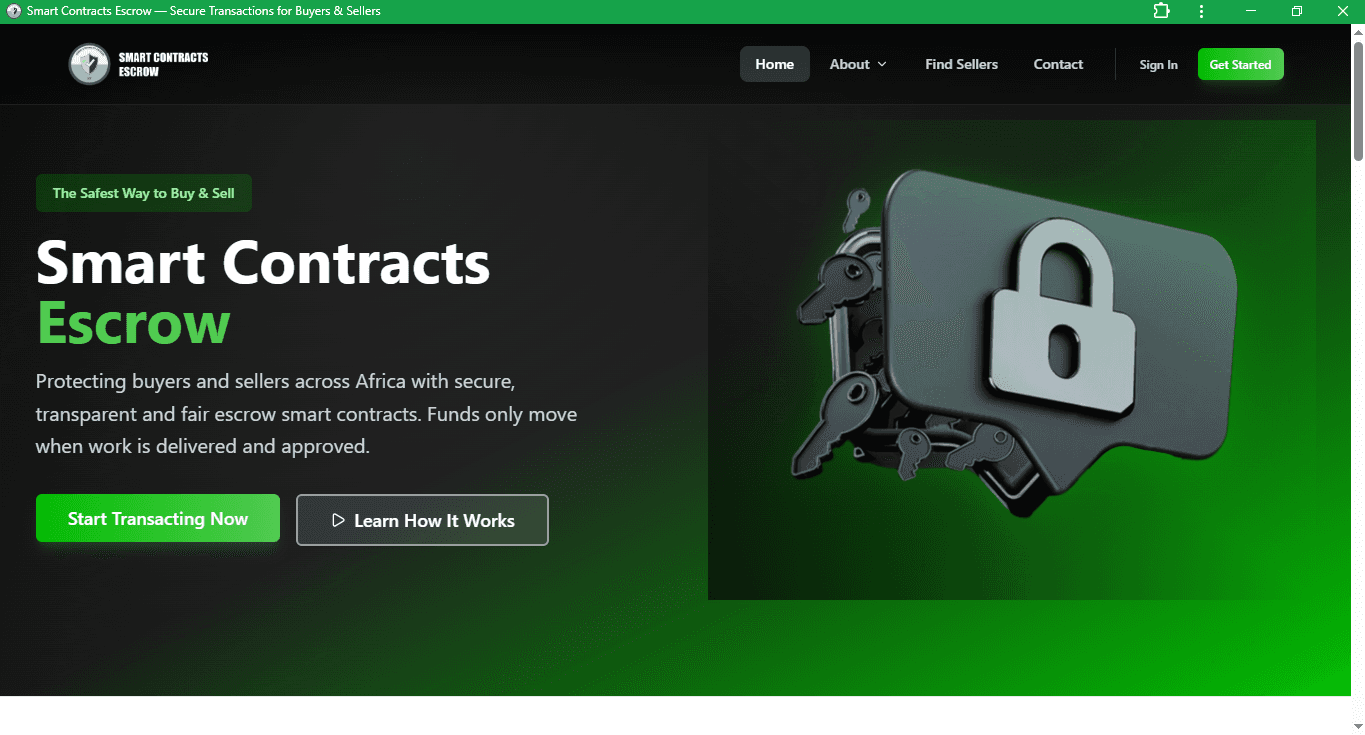
Smart Contracts Escrow is a fintech platform designed for and fully operated by Smart Contracts Escrow, with the system developed by Slyker Tech Web Services. It provides a secure and reliable way for buyers and sellers to transact online, acting as a trusted intermediary by holding funds in escrow until both parties meet the agreed terms of a transaction.
The process is simple and structured: a buyer initiates a transaction and deposits funds, the seller delivers the product or service, and payment is only released after confirmation. This eliminates the risks of upfront payments and non-delivery, ensuring fairness and accountability for both parties.
The platform is managed, controlled, and regulated by Smart Contracts Escrow, ensuring full operational oversight, compliance, and trust in all transactions conducted on the system. Built with a secure and scalable architecture, it supports milestone-based payments, transparent tracking, and controlled fund releases, making it suitable for freelancers, businesses, and marketplaces where transaction security is critical.
The challenge
The client wanted to create a more reliable way for people to transact when there was limited trust between the parties. The core problem was not simply accepting payments; it was ensuring that neither the buyer nor the seller was unfairly exposed during a transaction.
Buyers needed protection against paying for work that was never delivered or did not meet the agreed requirements. Sellers, meanwhile, needed protection against scope creep and situations where a buyer could withhold payment despite work being completed.
The client also wanted a genuine mechanism for resolving disagreements. If a buyer was dissatisfied, they needed a structured way to request revisions or raise a dispute rather than simply withholding funds. Likewise, sellers needed a process through which legitimate claims could be reviewed.
The initial alternative involved automating the process through WHMCS. However, WHMCS is primarily designed for web-hosting businesses and did not provide the purpose-built escrow transaction model the client envisioned.
Our solution
Slyker Tech designed and developed a dedicated escrow platform around the principle that both sides of a transaction should have clearly defined responsibilities and protections.
A buyer and seller can agree on the scope, price, milestones, deadlines and deliverables before committing to a transaction. The buyer then funds the escrow through Paynow: EcoCash, OneMoney and Telecash by push prompt, InnBucks by code or QR, O'mari/ZimSwitch by OTP, and Visa or Mastercard through web checkout. Bank transfers are accepted as proof of payment that staff approve, and every Paynow result is verified against its hash before it counts.
Every movement of money is recorded in a double-entry ledger. PostgreSQL itself enforces the rules: postings and journals are append-only, every journal must balance to zero, and an account cannot go negative. Writes are idempotent and accounts are locked while they change, and a reconciliation command checks the books end to end. Platform and processing fees are configurable and are booked to the ledger when an escrow is fully funded.
Funds remain in escrow while the seller completes the agreed work. A project can be structured as a single engagement or divided into multiple milestones, allowing larger projects to be delivered and approved progressively.
The platform uses 13 transaction states to control the lifecycle of an agreement, including seller acceptance, pending payment, escrow and release states, with an explicit transition table that rejects any illegal move. This state-aware approach allows the interface and available actions to reflect the actual status of a transaction.
When a seller submits a milestone, the buyer can approve it, request revisions or raise a dispute. Approved milestones trigger the appropriate payment release, allowing the seller to receive funds without requiring a manual payment process for every successful milestone.
For disagreements, Slyker Tech implemented a dedicated dispute engine in Erlang/OTP, where every dispute runs as its own supervised state machine. Django publishes dispute events over RabbitMQ, and the engine escalates a case automatically when the conversation runs long. Missed deadlines on funded deals open a dispute rather than leaving money in limbo. Staff can investigate disputes and make decisions based on the circumstances and available evidence. Depending on the outcome, funds can be released to the buyer, released to the seller, split between the parties or escalated for further handling.
Released funds land in a wallet. Users can fund new escrows from it, and withdrawals need an emailed one-time code and staff approval. A seller marketplace with verified seller profiles, categories and plans helps buyers find someone to deal with, and a trust score from 0 to 100, based only on escrows that were actually funded, shows how reliable each party has been. Every escrow carries a verifiable reference number.
Transaction states, dispute messages and notifications update in real time over WebSockets (Django Channels), with email, in-app and WhatsApp notifications.
Businesses can take escrow payments in their own checkout: a Merchant API with hashed API keys and idempotent writes, a hosted checkout that works for guests, a WooCommerce payment plugin and a Node SDK. Merchants receive 17 kinds of webhook event, signed with HMAC-SHA256 and retried for about three days.
The interface was deliberately designed around trust and simplicity, making the platform accessible to non-technical users while still providing the controls required for more complex transactions.
Results
- A custom escrow platform developed and delivered to Smart Contracts Escrow
- A secure transaction workflow for buyer and seller protection
- A fully functional milestone-based payment release system
- A structured escrow process to reduce fraud and payment disputes
- A scalable backend system for transaction management
- A responsive frontend interface for platform users
- Integrated transaction tracking and status visibility features
- Secure data handling and transaction protection mechanisms
- Deployment of the platform to a live hosting environment
- Ongoing technical support, maintenance, and hosting services